2004 indian ocean tsunami
At 07:58 local time on December 26, 2004, a massive underwater earthquake struck off the west coast of Sumatra, Indonesia. Lasting an agonising 8 to 10 minutes, it was the third-largest earthquake ever recorded, unleashing the destructive force of 1,500 Hiroshima atomic bombs. The devastation was unimaginable.
Read my story in The Guardian, “We have too many bodies,” for a first-hand account of the aftermath.
10-15 minutes after the earthquake, the first of three waves struck the north and west coast of Sumatra. Tsunamis were triggered in fourteen countries with landmass bordering the Indian Ocean.
Read my story in The Guardian, “Hit by the aftershock.”
Waves lifted large fishing boats out of the ocean and carried them many kilometres inland. Can you see the date scrawled on the boat?
Read my story in The Guardian, “A welcome deluge.”
Entire villages were sucked out to sea. Bridges and road were destroyed.
The death toll was devastating, with an estimated 230,000 to 280,000 lives lost across 14 countries. Indonesia was the hardest hit, accounting for approximately 220,000 of the total fatalities.
Banda Aceh will forever be remembered as the “Ground Zero” of the 2004 Boxing Day tsunami.
Just a sixty-minute drive west of Banda, the village of Lampuuk was situated closest to the epicentre of the catastrophic earthquake and tsunami. Here, 5,000 lives were lost, leaving only 1,000 survivors.
Many sought refuge in the sole structure left standing — the local mosque. Across the region, mosques often emerged as the only buildings resilient enough to withstand the surging waves, serving as a powerful symbol of hope and strength for the devoutly Muslim Acehnese. However, for some, the tsunami was interpreted as divine retribution, raising profound questions about faith and suffering in the aftermath of the disaster.
In the wake of the disaster, thousands of Red Cross volunteers surged forward, coming from every corner of Indonesia and beyond to lend a hand to those in need. I was profoundly moved by the sight of these young volunteers, their faces etched with determination and compassion as they laboured tirelessly in the sweltering heat and oppressive humidity.
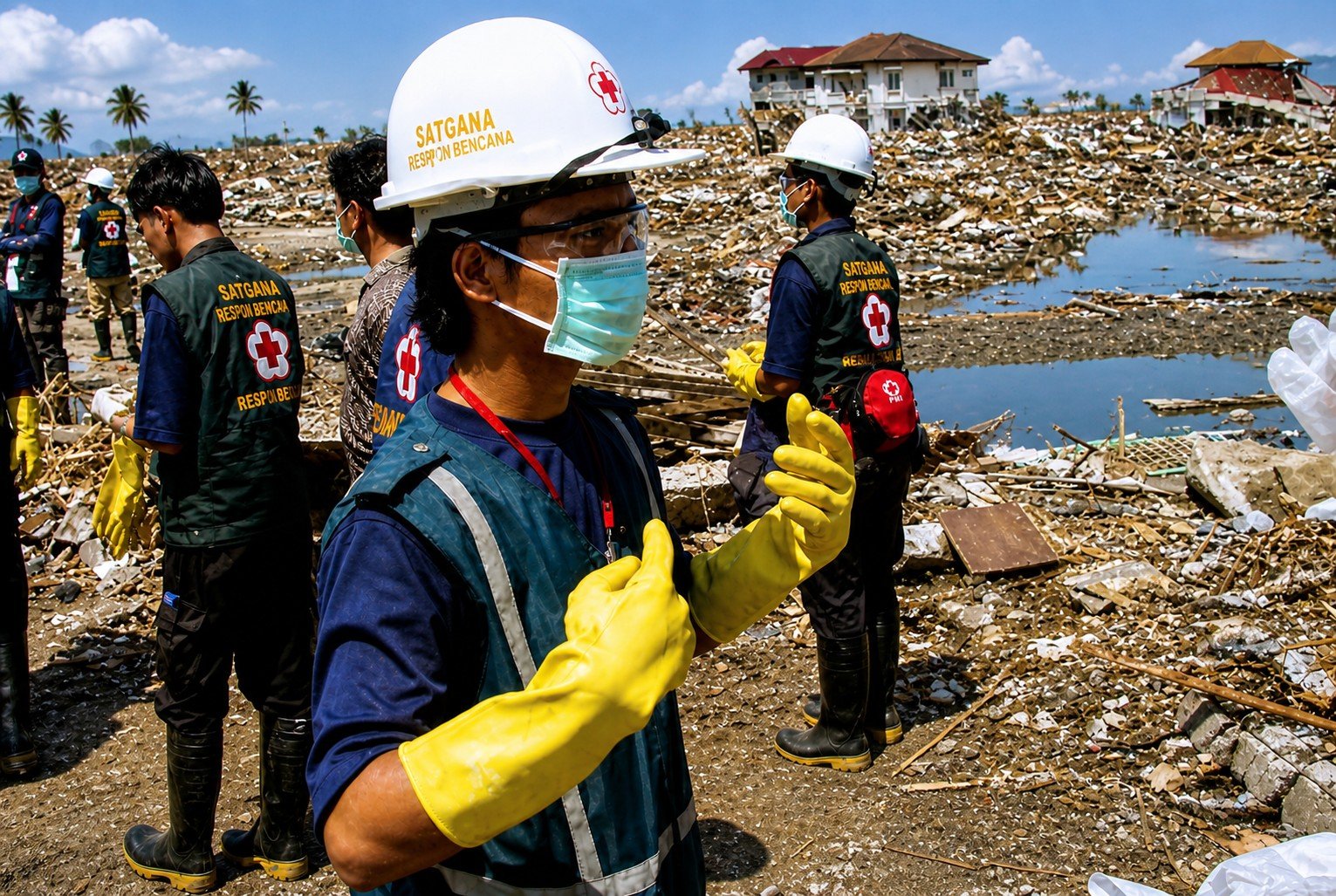
Day after day, they waded through the debris retrieving bloated dead bodies, each one a heart-breaking reminder of lives lost. Their selflessness and unwavering commitment to humanity in such harrowing conditions was awe inspiring; a testament to the resilience of the human spirit amidst unimaginable tragedy
“We have too many bodies,” a Red Cross volunteered told me. “But I am working for humanity. I am sad but it is my obligation.”
Volunteers, often Indonesian university students, collected dead bodies in the thousands.
In a race against time, the International Red Cross Red Crescent mobilised every resource at their disposal, chartering planes, helicopters, and boats to reach the most isolated communities devastated by the disaster.
They swiftly transported field hospitals and water purification units from as far away as the UK, Germany and Spain, determined to deliver life-saving aid to those needing it most.
In early January 2005, I joined an International Red Cross team on a charter flight to Meulaboh, on Aceh’s west coast. We travelled alongside a BBC crew and a unit of trauma surgeons and nurses from the Japanese Red Cross.
No aid had reached the town by the time we arrived. What we found defied comprehension and left a lasting mark on all of us.
Thousands of bodies lay in the streets, many already in advanced stages of decay. Others remained trapped beneath collapsed concrete and twisted metal. The air was thick with the stench of death, overwhelming and inescapable. It felt like stepping into a place beyond anything I had known.
I had encountered death before, but nothing prepared me for this—hundreds upon hundreds of people, where they had fallen, stretching as far as the eye could take in. The scale was impossible to process, and the memory has never faded.
BBC’s Andrew North and Cara Swift accompanied the International Red Cross to Meulaboh, becoming the first Western journalists to report from the ravaged west coast of Aceh Province.
As we picked our way through the destruction in the back of a large truck, survivors lined the streets, calling out, “BBC, BBC!” Their cries echoed with hope, knowing their plight would finally reach the world.
Later, we secured a lift to Medan aboard a Royal Singapore Airforce Chinook. Flying low over the lush Sumatran rainforest, with mist swirling beneath us, I took this photograph: Andrew North engrossed in writing a story for BBC News.
In Meulaboh, I remember giving an interview to the BBC, struggling to find words that could match what we were seeing. The only comparison that came to mind was the aftermath of Atomic bombings of Hiroshima and Nagasaki, images I had known only from history, now echoed in the devastation around us.
We turned the local hospital into our base, sleeping on a bare concrete floor for five exhausting days. Meals were whatever we had to hand, instant noodles and chocolate. The constant drone of backup generators filled the air, powering a makeshift operating theatre where the Japanese Red Cross team carried out basic surgeries. Even in that setting, the work never stopped. The urgency was relentless.
Amid it all, one moment has stayed with me more than any other. At an evacuation centre for those who had lost everything, I saw a young boy sitting alone. He was completely still, his chin resting on his hands, his expression empty, beyond tears, beyond reaction.
Over the years, I have often found myself thinking about him, wondering what became of his life. I hope that, somehow, he found his way to something better, growing up safe, cared for, and far removed from the weight of that time.
With coastal roads and bridges destroyed we relied on small planes and choppers to ferry humanitarian supplies and aid workers.
We experienced a white-knuckle landing at Meulaboh airstrip. As we approached, the pilot banked sharply to the left to navigate the battered runway, which had been severely cracked by the earthquake, allowing only the smallest planes to land.
Looking at the image, you can see the Japanese Red Cross trauma surgeons unloading vital medical equipment from the aircraft, ready to assist those in desperate need.
Medical staff from Japanese Red Cross unloading health kits to treat 10,000 people.
This is me in the cap, in discussion with the Spanish Red Cross team specialising in water purification.
For five days, I was immersed in their efforts, witnessing first-hand the incredible commitment of water engineers and technicians working around the clock to purify water that would be delivered to 4,000 families a day.
I hadn’t intended to stay so long, but with no helicopters landing near us, I found myself ‘stranded’ on Aceh’s west coast.
Eventually I was ‘rescued’ by a US Navy Seahawk, which flew me to Banda Aceh. But not before we landed on the deck of the American aircraft carrier, the USS Abraham Lincoln —an unforgettable experience.
In Meulaboh, Red Cross delivered water to 4,000 families every day.
Wherever we went, we met people relieved to receive support from the Red Cross Red Crescent.
Young and old, the tsunami spared no-one.
Here I am, leaning against a Red Cross helicopter, loaded and ready for take-off to Teunom. Around us, the scale of the response was extraordinary. U.S. Navy Seahawks from the USS Abraham Lincoln flew 22 sorties out of Banda Aceh, ferrying tonnes of medical supplies along with a German Red Cross doctor, three nurses, a lab technician, and a paramedic into the devastated area.
The health team’s equipment was as purposeful as it was compact. Packed into rugged metal boxes and assembled on site, it was designed to support the medical needs of up to 20,000 people. Within hours, nine white tents formed a functioning field hospital, complete with a maternity unit, pharmacy, waiting area, operating theatre, and laboratory.
The Boxing Day tsunami prompted one of the largest humanitarian relief efforts in history. Witnessing the profound acts of humanity amidst such devastation was a tremendous privilege. Being among those who sacrificed so much to help others was deeply humbling.
I returned to Aceh every six months for three years. During my visit in 2006, I concentrated on small business owners to investigate how financial grants from humanitarian agencies had empowered hundreds of families to rebuild their livelihoods.